Sunday, July 20, 2014

More Confessions from my Kitchen...

So if you are not a PCV or not interested in what I cook, you can just go ahead and skip this post. Apologies. But the truth is getting creative with food here is tricky, and so is making sure I eat enough veggies. So here goes some recent happenings in my 4 x 6 foot kitchen. I should also mention I haven't had a functioning refrigerator since April...

A little chick pea-cucumber-cilantro salad

Curried broccoli, cauliflower, carrots and onions over white rice with avocado.

Standard fried plantains with a fried egg and cheese. Fabulous hangover food.

Black bean burgers with tostones


Skillet potatoes with peppers and onions and fried eggs. Also great for hangovers.

Brown sugar glazed carrots, tuna cakes with dill mayo and lettuce salad with honey lime garlic vinaigrette. And fresh cheese. 

Coconut curry stew over white rice with fresh cilantro and cabbage salad and of course, avocado. 

Not pictured here:
Egg salad
Carrot bread
9.5 pounds of mangu (mashed boiled plantains with butter, for those of you who are not Dominican) complete with fried salami
The 12 other avocados I've eaten since the season has started 
Banana bread
Approximately a gallon of banana smoothie because someone gave me 25 ripe bananas that I had no idea what to do with.

Honey Garlic Lime Dressing
  • 1/4 cup fresh lime juice
  • 1/4 cup olive oil
  • 1 tablespoon honey
  • 1 garlic clove, pressed or finely minced
  • pinch coarse salt and pepper

Tuna Cakes

  • 1 6oz can of tuna fish in water or oil, drained
  • 1/2 small red onion, chopped
  • 1/4 cup celery
  • 1/2 cups panko bread crumbs
  • 1 clove garlic
  • 1 egg
  • Pinch of pepper
  • 2 tbsp olive oil
  • Fresh lime juice
Combine tuna, onion, bread crumbs and pepper in a bowl. Gradually add olive oil to make mixture into a sticky paste like texture. Form small patties and pan fry in a little bit of vegetable oil until brown on both sides a heated through. Drizzle with fresh lime juice and serve with light mayo mixed with fresh or dried dill. 

Black bean burgers
  • 1 (16 ounce) can black beans, drained and rinsed
These can be baked or grilled (pan fried in my case).
  1. In a medium bowl, mash black beans with a fork until thick and pasty.
  2. Finely chop bell pepper, onion, and garlic. Then stir into mashed beans.
  3. In a small bowl, stir together egg and hot sauce
  4. Stir the egg mixture into the mashed beans. Mix in bread crumbs until the mixture is sticky and holds together. Divide mixture into four patties.
  5. If grilling, place patties on foil, and grill about 8 minutes on each side. If baking, place patties on baking sheet, and bake about 10 minutes on each side.


Thursday, July 10, 2014

Celebrating the Home of the Free and the Brave

It's true, I never knew how American I really was until I left the US. I know sometimes PCVs feel like they sometimes even have to defend their country from stereotypes and harsh assumptions about the US. Best way to handle it? Make it a learning experience.

When it comes to celebrating the grand old flag, we definitely know how to do it. This year about 90 volunteers flocked to Bayahibe, a quant, whitewashed beach town in the east of the country. Per usual, we let loose. Without further adieu, here are the some pics (a few borrowed from Katy).


And upon my return to my site, I got the chikungunya. I'm all better now though. 

Hope you had a fabulous 4th!

Thursday, June 26, 2014

Why only Dominicans Can Turn an Epidemic into Pop Culture

Dominicans are hella good at small talk. I'd venture to say they're professionals. I'm going to go ahead and admit that I'm getting pretty good at it too. You see, there are a few main topics to touch on in standard small talk in the DR.

1. The weather. "hay dios, que calor" or "Oh lord it's so hot, "Quee solazoooooo" or "What sun!", "Nos vamos a quemar!" or "We're all going to burn up!" All typical phrases, especially this time of year when it's realllllly starting to get steamy up in here (listen to me, what am I talking about? This place is an inferno year round). Typical responses are, "Buuuuenoo" which is a stark agreement, "Que dios nos protege" or "God protect us" and the usual "hay si!" or "oh yes!". 

2. The family. "Y la familia?" so typical, and this island is seriously so small that even I who have been here for only a year and 3 months can talk to someone in the capital who knows someone in my pueblo who I know. Typical responses are, "ah tu no sabia que fulana 'ta embarazada otra vez?" or, "oh you didn't know that (so and so) is pregnant again?", "viviendo de uno" or "living off of one (that person)", and "estan bien!!" or "they're good!". 

3. The electricity or "luz". Asking what time it went out, what time it's coming back or how "ella no sirve" or "it's not worth a damn". Also consistent complaining about how it's never on.

And now ladies and gentlemen I present you with the newest topic for small talk that's caliente in the country right now.

La Chikungunya. Sometimes referred to as the Chimichanga, the chichiguya, or the "virus".

If you are reading this and you don't live in the DR, here's some background info on what it is. Chikungunya iMakonde for "that which bends up". It is transmitted similarly to dengue fever and causes an illness with an acute febrile phase lasting two to five days, followed by a longer period of joint pains in the extremities; this pain may persist for years in some cases. 

I think it's officially an epidemic. EVERYONE has had it and EVERYONE is talking about it. All you have to ask is, "so, have you gotten it yet?" on the bus and everyone erupts in conversation about how terrible it has been. 

This is a parody on a powdered juice label that's very popular in Latin America:


There was also recently a dembow (Dominican version of reggaeton) song and video made about it which you can see here. The mosquito pictured is actually very accurate, it looks just like the one that carries Chikungunya. 

It's no joke though, this has been wiping out entire pueblos at a time and in every organization there is at least one person sick with it. I see people hobbling to the corner store to buy their daily food items, grabbing walls and trees to be able to stand up. Some of my own family members had it weeks ago and are still suffering from joint pain, swelling and stiffness. It's even harder to see an infant or a small child struggle with it. 

As a development worker living in a developing country, it's eye opening to realize how much more prone these populations are to health issues and how fewer solutions there are for them. I'm sure in the cases in the US people have been hospitalized for days until they feel better but here people don't have options, they have to lay in their bed all day under a smoldering zinc roof with a fever that takes more than 24 hours to break. 

Public health have given workshops in almost all areas about filling in puddles, covering water tanks, sleeping with mosquito nets and using insect repellent. I just read here that totals in the caribbean have reached 190,000 reported cases. Doctors here in the DR are predicting that 5 million people (that's half of the population) will have had it by the end of the summer. 


But it sure does make great small talk to pass the time, and no, I have not gotten it yet. 
Hope you think of me next time you kill one of those clean US mosquitoes!

Kaley


Tuesday, June 24, 2014

Sealed the Deal

I've been holding off to post because I really wanted this to come before anything else (next up is about how a pandemic has become pop culture in the DR).

It's been (and will continue to be) a long journey. Remember this? Yeah. Countless times I've left La Red cursing under my breath and swearing that I'd never return.

We finally sent a container of cacao to our friends at Taza Chocolate.
There was lots of merengue tipico, mamajuana and beer as we waited for the container to arrive from Santo Domingo to load. As we waited, more and more people came. The container finally rolled in around 8pm and it felt surreal. I was always very unsure as to if I would ever see the day that a container leaves from our warehouse.  But I did.

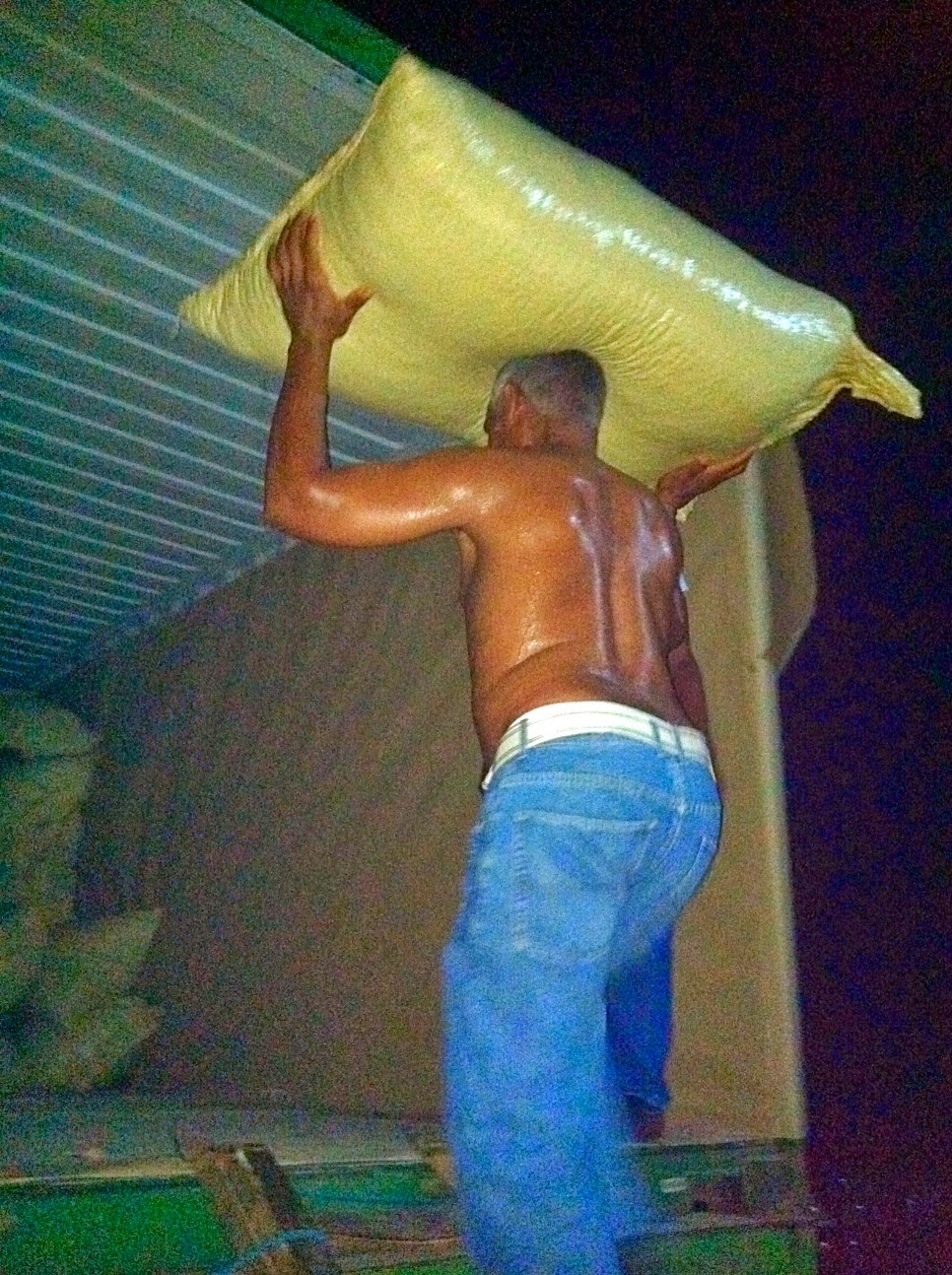
210 jute sacks full of fermented organic cacao. 14.7 metric tons. Blood, a lot of sweat and even some tears.


Each 140lb sack was hand (or head) loaded. 


Making the last one fit. 

And I couldn't be happier. The payment for that cacao will make life a little easier around La Red. What's next? Well, the harvest is pretty much over. I'd like to believe that we will continue buying cacao as it closes out but really we need to start financially planning for the next harvest in October and maybe look for some potential investors for pre-harvest purchase money. 
I have plans to make a formal website, finish the new labels for our cocoa powder that we sell and begin to settle some old debts that the coop has. 

But this week is bittersweet. One of our oldest board members who has been with La Red since the beginning, Carlos Suarez (pictured below, far left) suffered a heart attack late Saturday night and has been in the hospital since then. He is sorely missed at the project and we are all praying for him. 


Love from chocolate country, Kaley


Sunday, June 8, 2014

The day the bus driver saved my life...

If there were only one thing I could chose for you to understand about Dominican culture, you will find it here.

So the bus driver didn't really save my life. He saved my recent trip to the US though and gave me one of those mind jolting, reality-checking experiences that make you step outside your life and realize that maybe there is another way to look at things.

At 10 AM I carried my nearly empty suitcase down the stairs of my apartment complex and into my community's town hall vehicle to take me to Nagua to get on the bus to Santo Domingo.
"Do you have everything?" The driver, who is a family friend asked me in  Spanish.
"Of course!" I said. Obviously I was super excited to go back for a week and had thought this through a couple of times. We dropped off my keys at my host family's house and headed for the bus stop.

Normally I take the big air conditioned bus that doesn't stop and has a zero tolerance policy (everyone gets a seat and it is forbidden to talk to the driver during the trip), but that costs more and leaves less frequently, so I opted for the regular old guagua. We left at 11. Per usual, the guagua filled up 5 to a row back to front. About 30 minutes in to the ride, I realize my passport is on my dresser in my apartment. As we turn on to the main highway to head south, I tell the cobrador that he has to let me off because I didn't have my passport and my flight was at 4:30. I wasn't sure what I was going to do but I had to get back to my house.

The driver insists that this idea is ridiculous and that I'll never make it to the airport in time. Call your family, he says. Tell them to go get your passport and I'll call the bus stop to see if the driver will bring it down with him on the bus that leaves at noon. You can wait for him at the bus stop along the highway. I begin to sweat... and curse. The whole bus now knows what's going on. The woman sitting next to me with a chicken in a cardboard box on her lap grabs my hand and tells me to have faith and breathe. Yeah right, lady.

I call my host dad in a panic and explain to him what's going on and that I needed him to go get my passport. The next bus was leaving at 12, and it was now 11:45. He was in Nagua and my passport was 20 minutes away. I begin to tell him where it was in my house but of course, I lose cell phone signal as we pass through a national park. Meanwhile, my driver had called the next driver to tell him what was going on. He agreed, but said that he wouldn't wait. When we finally come out of the black hole of cell phone signal, I call my host dad. He located my passport and was on the way to the bus stop but I soon find out from my driver that the bus has already left. We call back and ask him to wait about 30 minutes outside of Nagua for my passport to be delivered. He agrees and then we lose signal again before I can tell my host dad where to meet the bus.

25 minutes later I'm drenched in sweat despite the blasting AC. I get signal back but I'm out of minutes. I borrow my bus driver's phone to find out what was going on. The passport was successfully delivered to the driver of the 12 o'clock bus. As I pass the news to the driver and the cobrador, the entire bus erupts in applause and the chicken lady gives me an "I-told-you-so" smirk.

When I arrive to the stop in Santo Domingo it's 1pm. My taxi guy is already there waiting for me and I explain that we have to wait an hour for the next bus to arrive before we can head to the airport. At 2pm, the bus pulls into the stop and the driver hands me my passport in it's gold case and says, 200 pesos (about $6). I would have given him 500. Passport in hand, I was off to the airport.


I know some of you are probably wondering how in the world I forgot my passport. Others are wondering how I put a document with my social security number on it in the hands of perfect strangers. I guess it's like the chicken lady said, have faith. This story is the best example I can give you about the hearts of Dominicans. They never worry, so why should I?
I couldn't think of a better way to leave the country I call home for a quick vacation to the US, which was fabulous!

xoxo, Kaley

Thursday, May 15, 2014

Why "Fair Trade" Isn't Really Fair


Connecting the chocolate supply chain from my Peace Corps service to your mid-afternoon sugar buzz

Let's face it. It's totally trendy to be conscious about where your food comes from. Americans and Europeans alike are more than willing to pay a little extra for a variety of premium items that morally connect the consumer to the product's origin.

Fair Trade is one of the most recognized certifications today. The logo which can most commonly be found on coffee and chocolate products signifies that a premium has been paid for the ingredients. Although I cannot speak for coffee, in cocoa that premium is critical for farmers. As it stands currently, the supply of cocoa is dwindling.
Cocoa doesn't grow just anywhere. The “cocoa belt”, is the tropical zone that spans 20 degrees north and south of the equator. Most cocoa farmers (I speak for the DR) are older (60+) and today's youth, which make up for nearly half of the population, are uninterested in taking over the family farms for fear being poor like their parents and grandparents. On the other end of the supply chain, chocolate consumption worldwide increases at an incredible rate each year. What does this all mean? Prices on all levels must increase in order to sustain the cocoa industry.

In a recent conference with other (Peace Corps) volunteers who work with cocoa we had the opportunity to speak with the official liaison for Fair Trade (FLO) in the Dominican Republic, Maria Trinidad.
Since the message to the consumer of Fair Trade products is intended to be ethical and the little Fair Trade logo appears on the final product, I wanted to know if Fair Trade required a certain amount (or all) of the ingredients in a chocolate bar (for example) to be Fair Trade sourced. The short answer is no. In fact, Maria went as far as to say that all ingredients in the bar that could be Fair Trade should be. As you may know, this is impossible. Things like sugar and vanilla, absolutely. But that chocolate bar contains quite a few more ingredients that are not Fair Trade. So the logo makes it all the way to the final product even though a very small amount of the ingredients are actually Fair Trade.
That being said, I want to mention that cocoa is a commodity that is purchased by the ton from origin. Large chocolate manufacturers buy thousands of tons of cocoa beans annually and not all of them are Fair Trade certified or from the same source. What is the likelihood of Fair Trade beans staying separate from the non-Fair Trade? In fact, Fair Trade uses a system called 'mass balance' when it comes to the certified final product. This means that for every chocolate bar made intended to be certified Fair Trade, that company must buy the equivalent mass of cocoa under Fair Trade terms. In other words, that's as far as Fair Trade reaches in content control of the final certified product and that in reality that chocolate bar may not contain Fair Trade cocoa beans at all.

Let's talk about the premium that is paid per ton for Fair Trade cocoa beans. In addition to the floor (minimum) price for the beans, Fair Trade pays $400 per ton. That breaks down to $20 per quintal (a quintal is 150 kilos). That money is paid out to the exporting organization at origin to cover administration costs and what's left over (?!) is distributed to the farmers. In short, the benefits are not enough. Not to mention the initial sign-up fee of 550 Euros in addition to the annual fee to stay certified.

Maria says that Fair Trade is the first step for small organizations to begin exporting. They get certified through larger organizations that have the capacity to export with the intent that in time they will be able to use the premiums paid out to export on their own. Here in the Dominican Republic Fair Trade's poster child is CONOCADO, the first organization to be Fair Trade certified in the country. CONOCADO started out as a cooperative for small cocoa producers and has turned into a three part mega company that is anything but small. However, for the last two years, CONOCADO has not distributed benefits to their cocoa farmers. They have lost more than 600 members nationwide since 2012. Basilio Almonte, head agronomist for CONOCADO was also present at the conference. When asked why they have failed to pay benefits to their members, he informed me that the organization had too many internal expenses and has not been able to distribute anything to the cocoa farmers. On a whole other level of opaque, the director of CONOCADO has opened his own private cocoa purchasing business, BIOCAFCAO, putting himself in direct competition with his employer, CONOCADO.
Maria Trinidad, well aware of the situation at the Fair Trade poster child, commented that although the transparency issues at CONOCADO are unfortunate it is the responsibility of the farmers to advocate for themselves and that Fair Trade cannot be involved in internal affairs of the certified exporting organizations.

If you are familiar with my job here in the DR with La Red Guaconejo, you have probably read about Taza Chocolate and their Direct Trade philosophy. Taza works exclusively with organic certified cocoa beans and on top of paying a minimum of $500 per metric ton above the New York International Commodities Exchange (ICE) price, owner Alex Whitmore visits the organization each year in order to ensure long-term personal relationships with the cocoa farmers. In my previous blog post you can read a little bit about Alex's most recent visit to the DR. What's in it for Alex, you may be asking? These relationships and purchasing principles allow Taza to manufacture and deliver a high quality, traceable chocolate bar with an ethical message and a real story to the consumer. The Somerville, MA based company is not exactly comparable to Nestle or Kraft (Mondalez). Most famous for their stone ground Mexican style chocolate disks, Taza has a unique market.

So what's the problem?
Is Fair Trade allowing consumers to believe that a $2 chocolate bar with their logo on it is just as ethical as an artisan chocolate bar that costs four times the price? Or will the trendiness of being “food conscious” or in this case “chocolate conscious” make for a saavy consumer that knows the difference?
That, my friends, is for you all to decide but I whole heartedly encourage you to be more aware of the origin of you next chocolate buzz.


Wednesday, May 7, 2014

Chocolate Country

Ay bendito.

April was maybe the busiest month of my life and May ain't getting any easier.

Since my last post lots of things have been happening.

Last week the owner of Taza Chocolate, Alex Whitmore,  was here visiting the coop and staying with me at my house. It was needless to say, an awesome experience. His visit last year was pretty brief. It was clear that La Red was in trouble. This year Alex got to meet the new board of directors and buying team and had the opportunity to really see what's going on inside the organization. 

If you don't know what Taza (Somerville, Massachusetts based chocolate company) is all about, check them out here. Super cool company. You should also check out their transparency reports that feature each place where they buy their organic beans from. 
Now watch this video so you can make the connection between Taza and my project. Seriously though go watch the video or you won't understand the importance of this post. 


Aside from the fact that we got some negotiating done, we will be sending a container of organic cacao (si dios quiere) to Taza in the beginning of June. I swear, when that container leaves port in Caucedo I'm going to drink and entire bottle of Brugal and dance for 3 days. No joke. 

The new team at Coop La Red Guaconejo with Alex

The president of the coop and I

Lunch and fresh coconuts


Speaking of dancing, Alex loves himself some merengue tipico. Lucky for him, that type of music and style of dance comes from Nagua! Monday night we went to a "tipico" which is a live merengue band that plays right on the beach. People put on their Monday best and head out to dance the night away. And that's just what we did. 

Alex dancing with our secretary Ariana

Early in the night. 

After an extremely late night, we headed out early to do some visits. Our first one was at the house of the ex-administrator of the coop. Although she is no long with La Red, Alex worked with her for many years and wanted to say hello. Here I am with her niece, Irvianni. 

From there our visits continued to OkoCaribe, another cacao association in San Francisco de Macoris where Alex buys organic beans. 


choco talk.

From there we headed down to the capital for some more meetings and further discussions of the industry and it's future. 

Alex's wife Kathleen designed our logo that you see on the sacks in the above pictures. He's been traveling down here for 7 years to work with La Red. They flew 5 members of the coop to the US in 2012 to see how chocolate is made in their factory. Alex pays $920 over NY market price per ton for our organic cacao because of it's quality (that's a really good price).
 He has made it clear that Taza will do whatever they can to see La Red successful and sustainable again and I'm more than grateful. And he brought me tons of chocolate and I'm now addicted to stone ground organic 70% dark, so thanks for that, Alex. 

It's been a long ride and as I said, it's long from over. 

Siempre pa'lante, Kaley

Juan UreƱa, a new member of coop Red Guaconejo with a cacao tree extremely flush with pods.